Overview
For Teams and Enterprise buyers, the fastest way to show value is to get them into the product. I built an interactive demo program in Storylane that puts the product right on our website, with no sign-up and the “aha” moments front-loaded, so each buyer can explore at their own pace.
I also wanted to prove marketing’s contribution to pipeline, and Sales wanted to know who was serious, so every demo session was wired into HubSpot.
What started as one tour on Beefree.io in 2024 grew into 12+ demos across Beefree and RGE Studio. I owned the program end to end: strategy, building and scripting the demos, voiceover, tracking and optimization.
The problem
- Value hidden behind a sign-up. A free trial existed, but it still meant creating an account, setting things up and hunting for the good parts alone. Teams and Enterprise buyers rarely have time for that.
- Invisible intent. Marketers couldn’t tell which visitors were seriously evaluating until they filled out a form.
- Marketing’s pipeline impact was hard to prove. Without a link between website engagement and deals, marketing’s role in revenue stayed a guess.
A product video could show the builder, but it couldn’t let people click around or tell us who watched.
The approach
Put demos where buyers decide
I placed demos at the highest-intent points on the site, led by the pricing page and a dedicated demo page. The pricing page demo alone brought in more than 320 leads.
Chapters, not a tour of everything
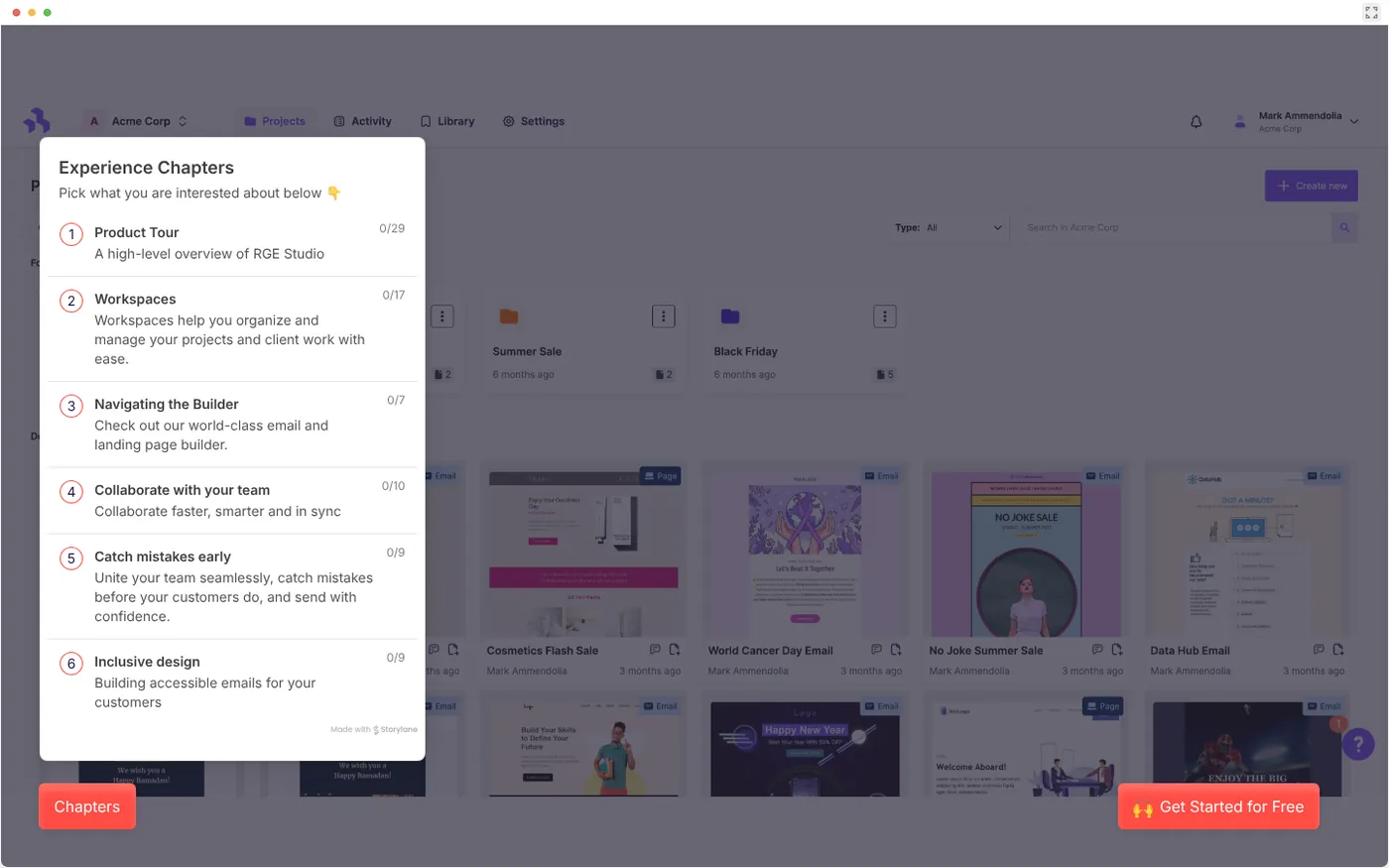
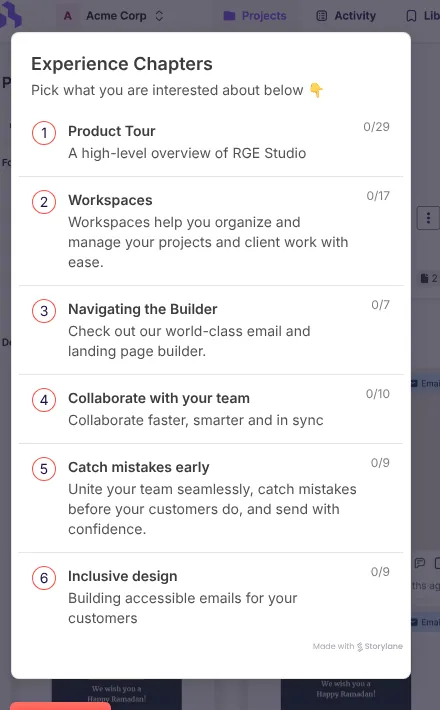
Instead of one long walkthrough, buyers pick what they care about from Experience Chapters: a product tour, workspaces, navigating the builder, collaboration, catching mistakes early and inclusive design.
Know who’s interested, even without a form
Storylane’s Account Reveal identifies the companies and contacts engaging with a demo, even if they never fill out a form. It tracks completion, time spent, the features people explored, the CTAs they clicked and whether they came back.
Wire it to the CRM from day one
After security and privacy reviews, Storylane connected straight to HubSpot. Known contacts and companies got a demo-activity signal on their record, earlier sessions synced once a visitor became a lead, and every call to action carried UTMs.
Alert Sales only when it matters
I worked with the sales team to set engagement thresholds for Slack alerts. A ping meant a visitor had engaged deeply enough to be worth a follow-up, not that someone clicked through once.
Building it
A library of 12+ demos
- General product tour. The main demo on the Beefree and RGE Studio pricing pages and the dedicated demo page.
- Feature demos. Workspaces, collaboration and catching mistakes early.
- Inclusive design. An accessibility demo, plus a five-tour self-guided demo course inside the Academy.
- CRM and integration demos. Our biggest deals were Enterprise teams on HubSpot and Salesforce, so showing those integrations was key.
- Industry demos. Tours built for specific ideal customer profiles, like higher education.
Script, voice and keep it current
Each demo is built from the real product, with a script guiding people through it. I voiced the first versions myself, then moved to AI voiceover so we could update and republish without re-recording. That kept the demos current through product updates and the RGE Studio rebrand.
Optimize for quality, not clicks
In early 2026 I ran A/B tests on lead capture. Moving the form deeper into the tour cut leads, so I tested the form up front against a linear journey with the form mid-tour, and required a work email to filter out personal accounts Sales couldn’t use.
When I reviewed the data on May 6, 2026, engagement had dipped but quality had jumped. Monthly leads climbed from 17 in February to 39 in April (+129%), more than double the 18-a-month target I owned, and lead-to-engagement conversion rose from 2.2% to 11.3%.
Pair demos with campaigns
Demos worked harder when other channels pointed to them. After launching the accessibility demo, the demo course in the Academy and paid ads for the higher education demo, engagement more than doubled month over month (+104%).
Impact
- $1.2M+ in demo-influenced pipeline and $680K+ in closed-won deals across Beefree and Really Good Emails, including several deals of $40K to $60K.
- 1,750+ CTA clicks and 500+ leads from enterprise and team plan prospects.
- 39 leads/month against an 18 leads/month target, after the 2026 optimizations (+129% from February to April).
- 55% engagement on the self-guided demo page, where more than half of visitors took the tour.
- Proof that marketing drives pipeline. Demo activity flowed into HubSpot, so Sales saw intent as it happened and every demo tied to real deals in a Sales Impact dashboard built with Growth Enablement.
How it’s measured. Pipeline counts opportunities where the prospect engaged with a Beefree or Really Good Emails interactive demo, matched to deals in the CRM. Closed-won is the portion of that pipeline that became paying customers.
Takeaways
Placement is strategy. On the pricing page, the higher the demo sat relative to the pricing table, the better it performed.
Measure intent, not activity. Fewer engagements with better qualification produced more than twice the leads.
Connect the data before you grow the library. Because Storylane fed HubSpot automatically, we could tie demos to pipeline instead of guessing.